
Members only · Official Soltan News
Soltan API 2.0: Connect Your Applications to Soltan Data
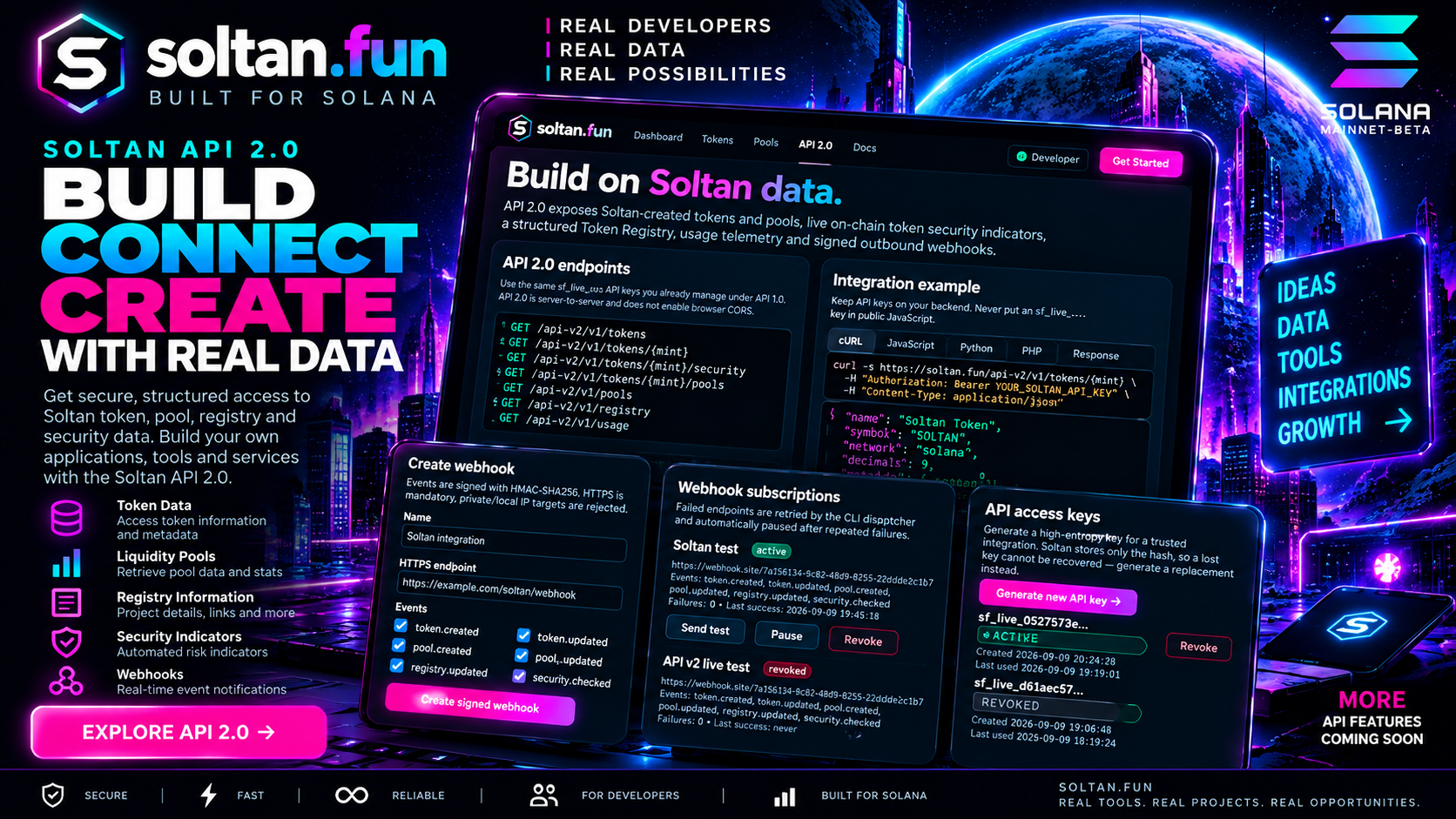
Soltan API 2.0 gives developers secure, structured access to Soltan token, pool, Registry and security data, with more API capabilities planned for future releases.
Soltan API 2.0: Building a More Connected Solana Ecosystem
We are excited to introduce Soltan API 2.0, our developer-focused API designed to provide structured and secure access to data available through the Soltan platform.
The Soltan API allows developers and services to retrieve Soltan token data, liquidity pool information, Token Registry information, automated security risk indicators and API usage information through documented endpoints.
What can developers use the Soltan API for?
The API can be used for many different types of legitimate data integrations and software projects. Developers can retrieve structured Soltan data and use that information within their own applications, services, analytics systems, monitoring tools, indexing systems and other software.
For example, developers can use the API to:
• Retrieve Soltan token information such as token name, symbol, description, network, decimals and available metadata.
• Access token metadata information, including available image URLs, allowing applications to display token logos when valid image metadata is available.
• Retrieve liquidity pool information and associated token data.
• Access public Token Registry information, including available project details, links, tags and verification status.
• Retrieve automated security risk indicators for supported tokens.
• Build data-driven analytics and monitoring systems around Soltan data.
• Keep external applications synchronized with supported Soltan events using webhooks.
• Create integrations that automatically process Soltan data for their own legitimate software or services.
The API is designed for server-to-server use. Developers should keep their API credentials secure and should never expose private API keys in client-side JavaScript, public source code or publicly accessible files.
Developers do not need to create or own every token or liquidity pool they retrieve through the API. Access depends on the endpoint and permissions associated with the API key.
Security and responsible use
Security is an important part of the Soltan API architecture. API access requires authentication, requests are rate-limited, and API credentials are associated with defined permissions.
Security results provided by the API are automated risk indicators based on available on-chain information. They should not be interpreted as a complete security audit, guarantee, investment recommendation or confirmation that a token is safe.
Developers are responsible for securing their own applications, API credentials, servers and users. API data should also be presented accurately and should not be manipulated in a way that could mislead users.
Webhooks
Soltan API 2.0 also supports signed webhook notifications for supported events.
Webhooks can allow developers to receive notifications when supported Soltan data changes instead of repeatedly requesting the API to check for updates.
Webhook requests include a cryptographic signature so that receiving applications can verify that the notification was generated by the Soltan webhook system.
Developers should always verify webhook signatures before processing incoming events.
More capabilities are coming
Soltan API 2.0 is only the beginning.
We are actively working on future improvements and additional capabilities that can make the Soltan ecosystem more useful for developers, projects and services.
As the platform evolves, we plan to expand the functionality available through our APIs and introduce additional tools, data and integration possibilities.
Our goal is to make it easier for developers to connect their own software and services with the Soltan ecosystem while keeping security, reliability and responsible API usage at the center of the platform.
The current API is available without a separate API subscription fee.
Developers can visit the Soltan API 2.0 section to explore the available endpoints, authentication requirements, usage information and integration documentation.
This is an evolving part of Soltan, and we look forward to introducing more API capabilities and developer tools in future updates.
← Back to Soltan News
We are excited to introduce Soltan API 2.0, our developer-focused API designed to provide structured and secure access to data available through the Soltan platform.
The Soltan API allows developers and services to retrieve Soltan token data, liquidity pool information, Token Registry information, automated security risk indicators and API usage information through documented endpoints.
What can developers use the Soltan API for?
The API can be used for many different types of legitimate data integrations and software projects. Developers can retrieve structured Soltan data and use that information within their own applications, services, analytics systems, monitoring tools, indexing systems and other software.
For example, developers can use the API to:
• Retrieve Soltan token information such as token name, symbol, description, network, decimals and available metadata.
• Access token metadata information, including available image URLs, allowing applications to display token logos when valid image metadata is available.
• Retrieve liquidity pool information and associated token data.
• Access public Token Registry information, including available project details, links, tags and verification status.
• Retrieve automated security risk indicators for supported tokens.
• Build data-driven analytics and monitoring systems around Soltan data.
• Keep external applications synchronized with supported Soltan events using webhooks.
• Create integrations that automatically process Soltan data for their own legitimate software or services.
The API is designed for server-to-server use. Developers should keep their API credentials secure and should never expose private API keys in client-side JavaScript, public source code or publicly accessible files.
Developers do not need to create or own every token or liquidity pool they retrieve through the API. Access depends on the endpoint and permissions associated with the API key.
Security and responsible use
Security is an important part of the Soltan API architecture. API access requires authentication, requests are rate-limited, and API credentials are associated with defined permissions.
Security results provided by the API are automated risk indicators based on available on-chain information. They should not be interpreted as a complete security audit, guarantee, investment recommendation or confirmation that a token is safe.
Developers are responsible for securing their own applications, API credentials, servers and users. API data should also be presented accurately and should not be manipulated in a way that could mislead users.
Webhooks
Soltan API 2.0 also supports signed webhook notifications for supported events.
Webhooks can allow developers to receive notifications when supported Soltan data changes instead of repeatedly requesting the API to check for updates.
Webhook requests include a cryptographic signature so that receiving applications can verify that the notification was generated by the Soltan webhook system.
Developers should always verify webhook signatures before processing incoming events.
More capabilities are coming
Soltan API 2.0 is only the beginning.
We are actively working on future improvements and additional capabilities that can make the Soltan ecosystem more useful for developers, projects and services.
As the platform evolves, we plan to expand the functionality available through our APIs and introduce additional tools, data and integration possibilities.
Our goal is to make it easier for developers to connect their own software and services with the Soltan ecosystem while keeping security, reliability and responsible API usage at the center of the platform.
The current API is available without a separate API subscription fee.
Developers can visit the Soltan API 2.0 section to explore the available endpoints, authentication requirements, usage information and integration documentation.
This is an evolving part of Soltan, and we look forward to introducing more API capabilities and developer tools in future updates.